



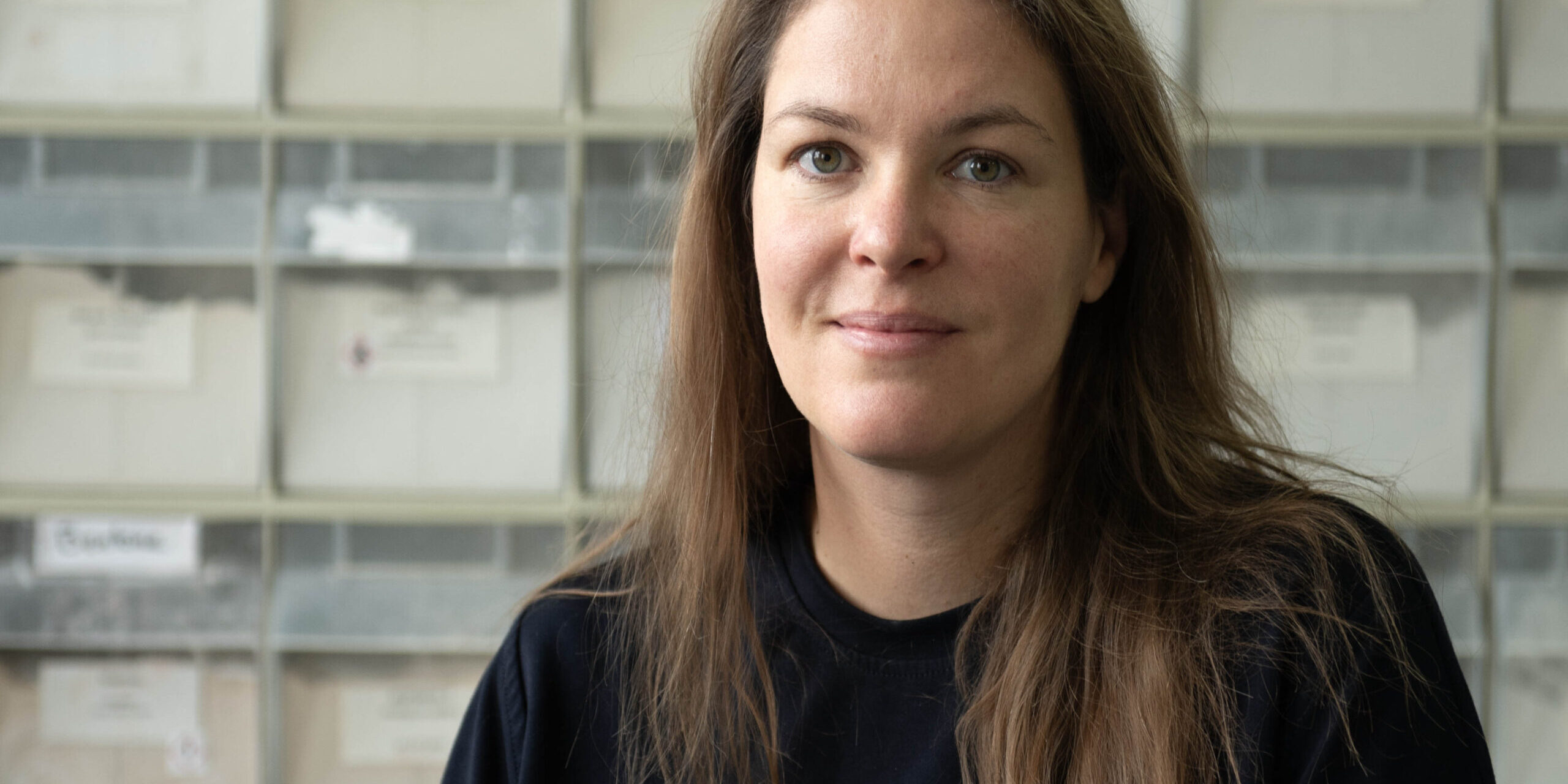
Photo: Arjan Lammerts
For the January edition of the alumni newsletter, we spoke with Dutch Fulbright alumna Lilian Kreutzberger. In 2011, she studied Fine Arts at Parsons School of Design, The New School, on a NAF-Fulbright grant. Her solo exhibition, RAUHFASER, on view at the Kröller-Müller Museum through March 1, 2026, is a layered presentation spanning four galleries that explores questions of digital reality, materiality, mental health, and grief. A perfect occasion to interview her and ask about her scholarship period, her artworks, and her work in The Hague’s Schilderswijk district.
Can you briefly introduce yourself?
My name is Lilian Kreutzberger. I received the NAF-Fulbright grant in 2011 for my Master of Fine Arts at Parsons School of Design, The New School.
Why did you choose Parsons?
I applied to several schools and was accepted to two or three, one of which also offered a scholarship. At the other programs, I didn’t feel very challenged. Parsons felt more conceptual and slightly more socially engaged. That’s why I chose Parsons.
What did you do after graduating?
I stayed in New York for another five years, first on a work visa, during which I also worked for the Netherland-America Foundation in New York. After that, I received an O-1 artist visa and spent several years developing my artistic practice in a studio in Brooklyn, combined with a number of artist residencies—free studio space and/or a stipend to work on new art projects for several months, such as at Socrates Sculpture Park, Eyebeam, and ISCP.
Eventually you returned to the Netherlands.
Yes, I returned to the Netherlands in 2015 for a postgraduate program at the Jan van Eyck Academy in Maastricht. I both underestimated and overestimated what it would mean to return. On the one hand, coming back is very practical: you move your belongings, close your bank account, say goodbye to friends, and get on a plane. But you also leave behind everything you’ve built and become used to, your social and professional network, a certain way of life and sense of urgency in the city. And what’s still there for you in the Netherlands is actually quite thin. So my plan was to return via a transitional step at the Jan van Eyck Academy, where you’re very sheltered in a program and meet lots of new people, and only then move back definitively to The Hague. So I first lived in Maastricht for a year, going from a huge city like New York to a small, almost village-like setting.
Was returning to the Netherlands and Maastricht a culture shock?
Yes, quite a bit, I think. But it’s strange, because you don’t really process it right away. You make a huge change, but at that moment you don’t really feel its impact. Once I was back in The Hague, it took me several years to really re-establish myself.
Is there something you learned at Parsons that you still use in your current practice?
Yes everything! I honestly think I wouldn’t be an artist anymore if I hadn’t done the MFA at Parsons. A year before starting my studies, I moved to New York. I was tired of the stress around getting a visa and applied for a Master’s. When I got accepted, I really had to decide if I wanted this. And I thought: if I don’t do this now, I’ll probably stop being an artist soon.
Back in the Netherlands, I had been very much trained in painting and in making work based on my own emotions. I realized I needed to expand my practice, but I had never learned how to do that. That new method and new ways of finding forms of expression for my interests, I learned at Parsons. There I learned to work in a theory-based way. So you don’t just respond to art and visual language, but you really develop ideas from texts as well. And because the program is part of a large university, I could also take courses in other departments. That was a unique situation for me.
Back to the present: what are you doing these days?
I’m still an artist, and in addition I work at an art school in The Hague’s Schilderswijk district, Art-S-Cool. There I set up the after-school program Future Institute of Art. The Schilderswijk is one of The Hague’s designated focus neighborhoods. It’s a very diverse area with a lot of social housing and many different nationalities. I live there myself. There are many organizations in the neighborhood, initiated by residents, that try to improve the area. You also see that reflected in positive news coverage when something happens there. There is a lot of talent in the neighborhood, but that talent doesn’t always find its way to the right educational opportunities.
The founder of Art-S-Cool, Laura van Eeden, started the school 15 years ago with the idea of offering a solution to this, or at least contributing to equal opportunities. Art-S-Cool offers 60 art classes per week, including three fixed days for young people aged 12 to 21. The Future Creators program is for young people who are less interested in drawing and fine art, but who can still be engaged through more accessible projects—like designing a T-shirt or tufting a rug.
At the moment, I’m working on a feasibility study commissioned by the municipality to explore the possibility of creating a shared makerspace in The Hague. I’m incredibly enthusiastic about this, and at the same time the need for children and youth, as well as for professional makers and artists—is so great that I spend a lot of time on it.
And besides that, you’re still an artist.
Correct, both exist side by side. Especially in recent years, and even more so in the U.S., there have been many conversations about inclusivity, and I always find it quite empty if that isn’t connected to concrete actions. I believe much more in actually doing something. In my own artistic practice, it doesn’t really fit my area of interest, so I engage with it through Art-S-Cool.
Your recent work as an artist: you have a solo exhibition at the Kröller-Müller Museum until March 1, 2026?
Yes, it’s a solo exhibition called RAUHFASER. It runs from September 2025 until March 1, 2026, which is amazing. I developed new work for it over the past two years. The basic idea or speculation I start from is that the future will resemble a digital screen. For example, I imagine everything being covered with a digital skin, made of micro-LEDs or virtual reality; a physical environment that increasingly merges with a digital reality.
To give a simple example: a table no longer has to be made of wood; it could also be an image of wood, and the next moment it could change into marble or something else. From that idea, I try to create works. I also think about what it would look like if the world were like the digital realm, and whether there are already areas that resemble this. One thing you really notice is that in the digital environment, the private and public completely mix, like ads in your email. So this already exists in real life.
In New York, for example, you have privately owned public spaces. These are areas where developers initially get some regulatory leeway if they also contribute something to the public space. But after a while, people forget that it was public, and the space becomes increasingly privatized, with blurry rules about how you’re supposed to behave. That was also a source of inspiration.
For the exhibition, I collaborated with Belgian writer Lize Spit. For one of the artworks, she interviewed twenty people who had undergone EMDR trauma therapy and then created a text based on those interviews.
Do you have advice for people who want to study art now, and do you think there is enough work in that field?
No, never. But I always think: if you’re an art nerd and you’ve been making art your whole life and it’s the thing you enjoy most and want to do most, then it really doesn’t matter whether there’s demand for what you offer afterward. I ask myself the same question when offering free art classes to children from underserved neighborhoods. You do something you deeply believe in and that makes you happy. And yes, maybe ten percent will become fairly successful at some point in their careers, or maybe twenty percent—but around that there is always a whole ecosystem.
I think the creative process you learn at an academy becomes a kind of life attitude that’s very productive in many areas and also contributes to your resilience. You learn to have an idea, find references, try different things, fail ten times, try again, learn from it, and gradually build something that works. And in a future where AI becomes more and more dominant, creative thinking, making connections, and being able to go through that process will remain essential, I think. That applies to any field.
As an artist, you need to be extremely resilient to keep going during school and beyond and to stay motivated to initiate something from your own ideas. Those are all qualities you can also use in other areas of life.
Where do you get your inspiration from?
From images, from materials and techniques, from things I read, from conversations, from what’s happening in society. All of that accumulates in your intuition or subconscious, where you can combine many things and make many more connections. For example: micro-LED and LED panels, working with digital 3D models, but also pushing the boundaries of what’s possible with ceramics I find that exciting.
My background is in painting, so I’m interested in notions of what is real and what is a surface that refers to reality, and how those relate to each other. And of course, just from life itself. For example, the title of the exhibition Rauhfaser refers to a type of wallpaper, but phonetically it also sounds like a period of mourning (rouwfase in Dutch). For me, the past few years have been quite difficult, with grief playing a central role. So that inevitably comes into the work.
Personally, in the way I work, I always try to create some distance by making very poetic work. Nothing is ever directly what it is, but you look for other ways to convey it.